
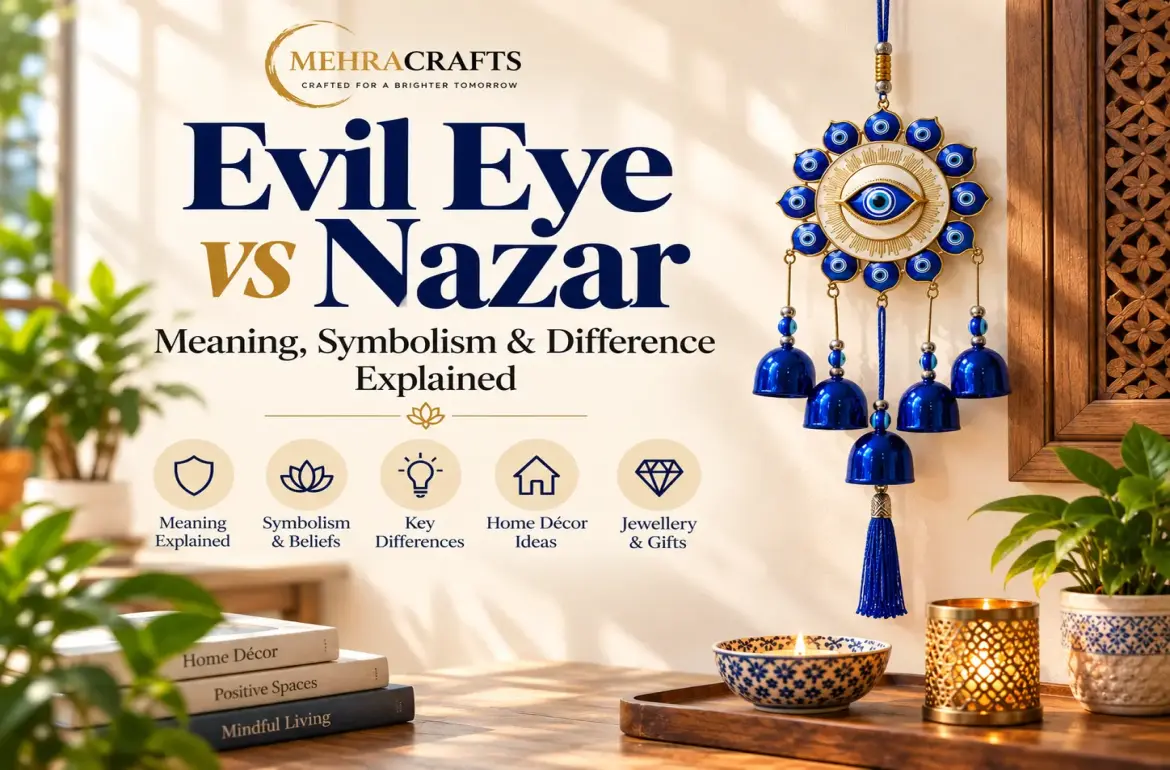
If you have ever seen a blue eye-shaped charm, bracelet, wall hanging, or amulet and wondered whether it is called an evil eye or Nazar, you are not alone.
The two terms are closely connected, but they are not always used in exactly the same way. “Evil eye” generally refers to the belief or concept of a harmful gaze, while “Nazar” is commonly used for the protective symbol associated with that belief.
In this guide, we explain the evil eye meaning, Nazar meaning, symbolism, differences, and how these designs are used in jewellery and home décor.
What Is the Evil Eye?
The evil eye refers to a traditional belief that a person's envious, jealous, or harmful gaze can bring misfortune or negative influence to another person.
The concept appears in different cultures and traditions, with variations in how it is understood and represented.
Today, the evil eye has also become a widely recognized decorative and fashion symbol, appearing on:
-
Bracelets
-
Necklaces
-
Charms
-
Keychains
-
Wall hangings
-
Wind chimes
-
Home décor
-
Accessories
The meaning can therefore depend on the cultural context and the person using the symbol.
What Does Nazar Mean?
Nazar is a term commonly associated with the evil eye belief and is particularly familiar in South Asian, Middle Eastern, Turkish, and surrounding cultural contexts.
The word is often used to describe the idea of an unwanted or harmful gaze. In everyday usage, however, Nazar can also refer to the protective amulet or symbol used in connection with that belief.
The familiar blue circular eye symbol is commonly called a Nazar or Nazar amulet.
Evil Eye vs Nazar: What Is the Difference?
The simplest way to understand the distinction is:
| Evil Eye | Nazar |
|---|---|
| Refers to the belief or concept of a harmful gaze | Commonly refers to the Nazar concept or protective symbol |
| Describes the traditional belief | Often used for the eye-shaped amulet or charm |
| Found across many cultures | Particularly familiar in South Asian, Turkish and Middle Eastern usage |
| Can describe the phenomenon itself | Often describes the symbol used to represent or guard against it |
However, everyday usage is not always strict. People frequently use “evil eye” and “Nazar” interchangeably, especially when talking about the familiar blue eye symbol.
So, if someone calls a blue eye-shaped wall hanging an evil eye decoration or a Nazar wall hanging, they are generally referring to the same visual tradition.
Is Nazar the Same as Evil Eye?
They are closely related, but the terms can refer to slightly different things.
Think of it this way:
Evil eye → the belief/concept
Nazar → the term and symbol commonly associated with that belief
The exact meaning can vary according to cultural and regional usage, so there is no single definition that applies identically everywhere.
Why Is the Nazar Usually Blue?
Blue is strongly associated with many traditional Nazar designs.
The classic design often features:
-
Deep blue
-
Light blue
-
White
-
A dark central circle
This combination creates the instantly recognizable eye motif.
Blue Nazar designs are now also popular in contemporary décor because the colour works particularly well with neutral interiors such as white, beige, cream, grey, and natural wood.
What Does the Blue Evil Eye Mean?
The blue evil eye is commonly associated with the traditional Nazar symbol and is often interpreted in connection with protection from the evil eye.
For many people, it also has decorative and cultural significance.
It is important to distinguish traditional or spiritual beliefs from scientifically established effects. The idea that a Nazar physically prevents negative energy or misfortune is a cultural or spiritual belief rather than a scientifically established fact.
Evil Eye and Nazar in Home Décor
The familiar blue eye symbol has moved beyond traditional amulets and is now used in many forms of interior decoration.
You may find it as:
-
Wall hangings
-
Wind chimes
-
Glass ornaments
-
Decorative charms
-
Hanging accessories
-
Tabletop décor
A Nazar-inspired wall hanging can work particularly well in:
Entranceways
Use a decorative hanging near the main entrance to create a distinctive focal point.
Living Rooms
A blue evil eye design can add colour to a neutral wall or console area.
Balconies
Wind-chime-style Nazar décor can complement plants, natural textures, and relaxed outdoor spaces.
Offices
A smaller evil eye ornament can add personality without taking up desk space.
Evil Eye and Nazar Jewellery
The symbol is also widely used in jewellery and accessories.
Popular forms include:
-
Evil eye bracelets
-
Nazar bracelets
-
Evil eye charms
-
Nazar necklaces
-
Evil eye earrings
For example, MehraCrafts offers a Blue Evil Eye Hamsa Charm Bracelet featuring blue evil eye beads, silver-toned spacers, Hamsa charms, and decorative bead accents. It is designed as an everyday accessory and gifting option.
The Blue Evil Eye Hamsa Bracelet is another option, combining glossy blue beads, silver spacers, and a Hamsa hand charm in a stretchable design.
Evil Eye & Nazar Décor at MehraCrafts
If you prefer home décor rather than jewellery, MehraCrafts has several Nazar-inspired wall-hanging designs.
Evil Eye Glass Wall Hanging
The Evil Eye Glass Wall Hanging features a blue glass Nazar centerpiece, decorative beads, and a hanging cord. Its circular design works well for entrances, living rooms, offices, balconies, cafés, and workspaces.
Evil Eye Wind Chime Wall Hanging
The 15-inch Evil Eye Wind Chime Wall Hanging features a blue Nazar centerpiece and five decorative metallic bells. It is listed as suitable for entrances, living rooms, balconies, offices, and gifting.
Hamsa Evil Eye Wind Chime
The 11-inch Hamsa design combines a Hamsa hand with blue Nazar accents, five metallic bells, and a decorative tassel.
Evil Eye Owl Wind Chime
For a more decorative variation, the Evil Eye Owl Wind Chime combines an owl motif with blue Nazar accents, three metallic bells, and a tassel.
Evil Eye & Om Metal Hanging
The Blue Evil Eye & Om Metal Hanging combines the Om symbol with evil eye detailing, blue beads, bells, and a tassel. MehraCrafts lists it for home, office, car, and meditation spaces.
Ready to add this meaningful symbol to your space? Explore MehraCrafts' evil eye and Nazar-inspired collection and choose a design that matches your style.
Evil Eye vs Nazar: Quick Summary
The difference becomes easier to understand when simplified:
-
Evil eye generally describes the belief in a harmful or envious gaze.
-
Nazar is closely associated with this belief and is commonly used for the protective eye symbol or amulet.
-
The familiar blue eye design is often called both an evil eye and a Nazar.
-
Usage can vary between cultures and regions.
-
Today, both terms are widely used in jewellery, accessories, and home décor.
Final Thoughts
Evil Eye and Nazar are closely connected terms, but they can carry slightly different meanings depending on cultural and regional context.
The evil eye generally refers to the belief surrounding a harmful gaze, while Nazar is commonly associated with the symbol or amulet connected with that belief.
Whether you appreciate the symbol for its cultural meaning, traditional symbolism, or simply its distinctive blue design, Nazar-inspired décor and jewellery can add a memorable touch to your personal style or home.
Explore the MehraCrafts collection of evil eye and Nazar-inspired products and find a piece that suits your space or makes a meaningful gift.