
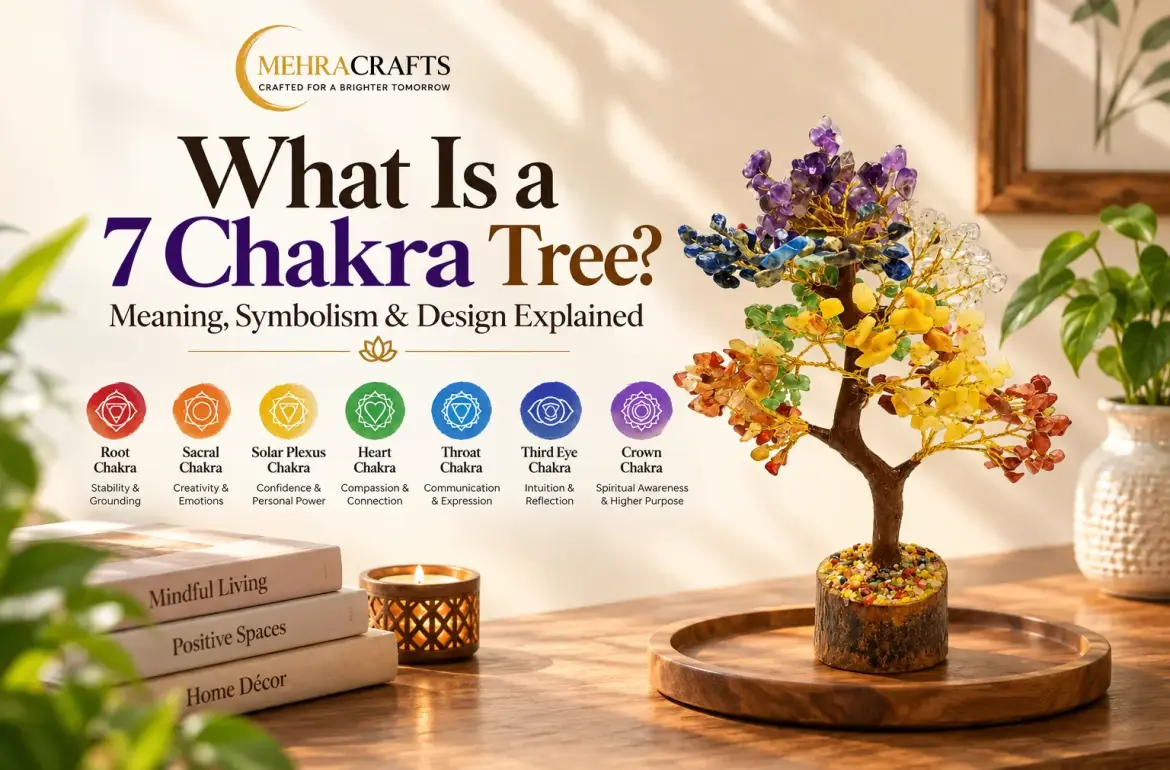
A 7 Chakra Tree is a symbolic tree design inspired by the seven chakras described in Indian spiritual traditions. Its colourful branches typically represent the different chakra colours, while the tree form can suggest growth, connection and the relationship between different aspects of life.
Unlike a general decorative tree, a chakra tree brings together two symbolic ideas: the seven-chakra system and the tree as a symbol of development and interconnectedness. Understanding these ideas can help you appreciate what the design represents, why its colours matter and how to distinguish traditional symbolism from modern interpretations.
In this guide, we’ll explore the meaning of a 7 Chakra Tree, the symbolism associated with each colour, the significance of its tree-like structure and a few common misunderstandings about chakra-inspired designs.
What Is a 7 Chakra Tree?
A 7 Chakra Tree is a tree-shaped design inspired by the seven chakras. Depending on its construction, it may feature colourful stone chips, beads, crystals or other decorative materials arranged across branches.
The seven colours are commonly associated with seven energy centres in the traditional chakra system. A tree design brings those colours together in one visual form, creating a symbolic representation of the complete chakra sequence.
The word chakra comes from Sanskrit and is commonly translated as “wheel.” In Indian spiritual traditions, chakras are understood as centres associated with different dimensions of human experience. Interpretations vary across traditions, and modern wellness descriptions do not always reflect the full complexity of their historical origins.
A 7 Chakra Tree is therefore best understood as a symbolic design inspired by this system—not as proof that a physical object can automatically change a person's health, emotions or circumstances.
What Does a 7 Chakra Tree Symbolise?
The meaning of a chakra tree comes from the combination of its colours and its tree form. Three ideas are particularly useful when interpreting the design.
1. Connection between the seven chakras
The seven colours are often shown together to represent the full sequence of chakras, from the root chakra at the base to the crown chakra at the top.
When viewed as one design, they can serve as a reminder that different areas of life—such as stability, confidence, communication and reflection—are interconnected rather than completely separate.
2. Growth and development
Trees are widely used as symbols of growth because they develop from roots into a trunk, branches and leaves. In a chakra-inspired design, this structure can be interpreted as a visual metaphor for personal development.
The meaning is symbolic rather than universal. Some people may associate the tree with learning and self-awareness, while others may simply appreciate its colourful, nature-inspired form.
3. Balance and wholeness
The seven-colour arrangement brings several symbolic elements into one composition. For people interested in chakra traditions, it can represent the idea of considering different aspects of life together.
However, the appearance of a balanced design does not demonstrate that someone's chakras are balanced. Its value may instead lie in personal meaning, cultural interest or its use as a reminder for reflection.
The Seven Chakra Colours and Their Traditional Meanings
The colours commonly associated with the seven chakras are red, orange, yellow, green, blue, indigo and violet. Their meanings are interpretations within spiritual and modern wellness frameworks; they are not scientific measurements of a person's physical or emotional state.
1. Root Chakra — Red
The root chakra, commonly called Muladhara, is associated with grounding, stability and a sense of security. Red is often used to represent these themes because it is visually strong and connected with ideas of vitality and rootedness.
In a seven-colour tree, red often appears toward the lower part of the arrangement, reflecting the root chakra's position at the base of the traditional sequence.
2. Sacral Chakra — Orange
The sacral chakra, or Svadhisthana, is commonly associated with creativity, emotions and relationships with pleasure. Orange represents this chakra in many modern colour-based explanations.
Within a chakra tree, the orange element can symbolise creative expression and openness to experience.
3. Solar Plexus Chakra — Yellow
The solar plexus chakra, known as Manipura, is often linked with confidence, personal agency and determination. Yellow is the colour most commonly associated with it.
Its place in the colour sequence can be interpreted as a reminder of self-belief and the ability to make considered decisions.
4. Heart Chakra — Green
The heart chakra, or Anahata, is associated with compassion, care and connection. Green is its most familiar colour in modern seven-chakra charts.
In a symbolic tree design, green may represent the importance of kindness, understanding and meaningful relationships.
5. Throat Chakra — Blue
The throat chakra, called Vishuddha, is commonly connected with communication, expression and speaking truthfully. Blue is the colour generally used to represent it.
This part of the sequence can be interpreted as a reminder to communicate clearly and listen thoughtfully.
6. Third Eye Chakra — Indigo
The third eye chakra, or Ajna, is associated in modern chakra explanations with intuition, perception and inner reflection. Indigo is commonly assigned to this chakra.
Its symbolism may encourage a person to pause, examine their assumptions and reflect before making decisions.
7. Crown Chakra — Violet
The crown chakra, known as Sahasrara, is often associated with spiritual awareness, contemplation and a sense of connection with something beyond the individual self. Violet is commonly used to represent it, although some colour systems use white or other variations.
At the top of the sequence, it completes the seven-colour arrangement.
Quick reference: the seven colours
| Chakra | Common colour | Common symbolic association |
|---|---|---|
| Root | Red | Stability and grounding |
| Sacral | Orange | Creativity and emotions |
| Solar Plexus | Yellow | Confidence and personal agency |
| Heart | Green | Compassion and connection |
| Throat | Blue | Communication and expression |
| Third Eye | Indigo | Intuition and reflection |
| Crown | Violet | Spiritual awareness |
These associations are a useful introductory guide, not a universal rulebook. Chakra interpretations and colour correspondences can differ between systems.
Why Is a Tree Used to Represent the Chakras?
The tree shape adds another layer of meaning to the seven-colour concept. A tree is not itself one of the seven chakras; it is a separate visual symbol that can complement the chakra sequence.
Roots represent foundations
A tree depends on its roots for stability. This makes roots a natural metaphor for the foundational themes commonly associated with the root chakra, such as security and groundedness.
The trunk represents continuity
The trunk connects the roots with the branches. Symbolically, it can suggest continuity between different stages of growth or different aspects of personal experience.
Branches represent expansion
Branches spread outward and develop in different directions. In a symbolic interpretation, they can represent opportunities, learning and the many ways a person grows over time.
The complete tree represents interconnectedness
The roots, trunk and branches function as parts of one living structure. This offers a simple visual analogy for the idea that different needs, values and experiences can influence one another.
This interpretation comes from the symbolism of trees. It should not be confused with a formal rule of the traditional chakra system.
What Is the Connection Between a Chakra Tree and the Tree of Life?
The terms chakra tree and Tree of Life are sometimes used together in modern decorative designs, but they do not mean exactly the same thing.
A chakra tree specifically draws on the seven-chakra concept and its associated colour sequence. A Tree of Life is a broader symbol found in different cultures, religious traditions and philosophical systems, with meanings that can include interconnectedness, continuity, family, growth and the relationship between different forms of life.
A decorative tree may combine elements of both: the seven chakra-inspired colours and the branching form of a Tree of Life. When that happens, the design blends two symbolic ideas rather than representing one single, universally defined tradition.
If you are interpreting a particular design, look at what it actually includes. Seven distinct colour groups may signal a chakra-inspired theme, while roots and spreading branches may evoke the wider Tree of Life motif.
What Are the Benefits of Understanding 7 Chakra Tree Symbolism?
People may be drawn to a chakra tree for different reasons. Understanding its symbolism can make the design more meaningful without assuming that the object has supernatural or medical effects.
-
Learning about chakra traditions: The colour sequence offers a starting point for exploring the names and common associations of the seven chakras.
-
A visual reminder for reflection: Some people use symbolic objects as prompts to think about qualities such as confidence, communication or compassion.
-
Appreciating symbolic design: Knowing why the colours and branches are arranged in a particular way can make the visual composition easier to understand.
-
Connecting with personal meaning: A person may associate a particular colour or the tree form with a personal goal, memory or value.
-
Starting conversations: Chakra-inspired artwork can prompt discussions about symbolism, cultural traditions and different approaches to mindfulness.
These are possible interpretive or personal benefits. There is no reliable basis for claiming that simply owning or displaying a chakra tree guarantees healing, attracts wealth or changes a person's energy.
How to Read the Design of a 7 Chakra Tree
Not every tree-shaped object with colourful stones follows the same symbolic system. If you want to understand a particular design, consider these details.
Look at the colour sequence
Check whether the design uses the familiar seven-colour arrangement. Some pieces use all seven colours distinctly, while others use blended shades or a more decorative arrangement.
Notice the order of the colours
Many seven-chakra illustrations place red toward the root end and violet toward the crown end. A decorative object may not follow this sequence precisely, so avoid assuming that every branch represents a specific chakra unless the maker identifies it that way.
Distinguish material from symbolism
A tree made with coloured beads or stone chips may be inspired by chakra colours without containing seven verified types of natural crystal. Colour alone is not evidence of mineral identity.
If the exact gemstone matters to you, check the material description rather than relying only on appearance or the product's name.
Consider the tree structure
The branches, trunk and base may add a Tree of Life-inspired dimension to the design. This is a separate layer of visual symbolism from the chakra colour sequence.
Together, these details help explain what the design is intended to communicate without assigning unsupported meanings to every individual element.
Common Misconceptions About 7 Chakra Trees
Myth 1: A chakra tree automatically balances all seven chakras
The seven-colour arrangement represents the chakra system symbolically. Owning or displaying an object does not establish that a person's chakras have changed or become balanced.
Myth 2: Every colourful tree contains seven natural gemstones
Some designs use genuine mineral pieces; others use coloured beads, stone chips or mixed decorative materials. The materials depend on the individual product, so check its specifications.
Myth 3: Every chakra tree has exactly the same meaning
Colour associations are common, but interpretations can vary by tradition, design and individual belief. A decorative object may combine chakra-inspired colours with other motifs.
Myth 4: The tree's symbolism is the same as the traditional chakra system
The chakra sequence and the Tree of Life motif have different symbolic backgrounds. A modern design can bring them together, but they should not automatically be treated as one ancient, standardised symbol.
Myth 5: Chakra symbolism is a substitute for professional care
Spiritual symbolism may be meaningful to some people, but a decorative object should not be presented as a treatment for medical or mental health conditions. Personal beliefs and professional healthcare serve different purposes.
Final Thoughts
A 7 Chakra Tree brings together the symbolism of the seven chakras and the familiar image of a growing tree. Its colours are commonly associated with themes ranging from stability and creativity to communication and spiritual reflection, while its branches can suggest growth and interconnectedness.
The most useful way to understand the design is to separate its symbolic meaning from claims about guaranteed results. The seven colours can help explain the chakra-inspired theme, and the tree form can add a broader metaphor for growth. Together, they create a design that can be appreciated for its cultural references, visual structure and personal significance.
If you would like to see how these ideas are expressed in a real decorative design, you can explore the 7 Chakra Gemstone Tree Showpiece from MehraCrafts. Review the product details to understand its actual materials and construction, while using this guide as a reference for the symbolism behind the design.